Svensk version
War, arms race and UN crisis as a democracy problem
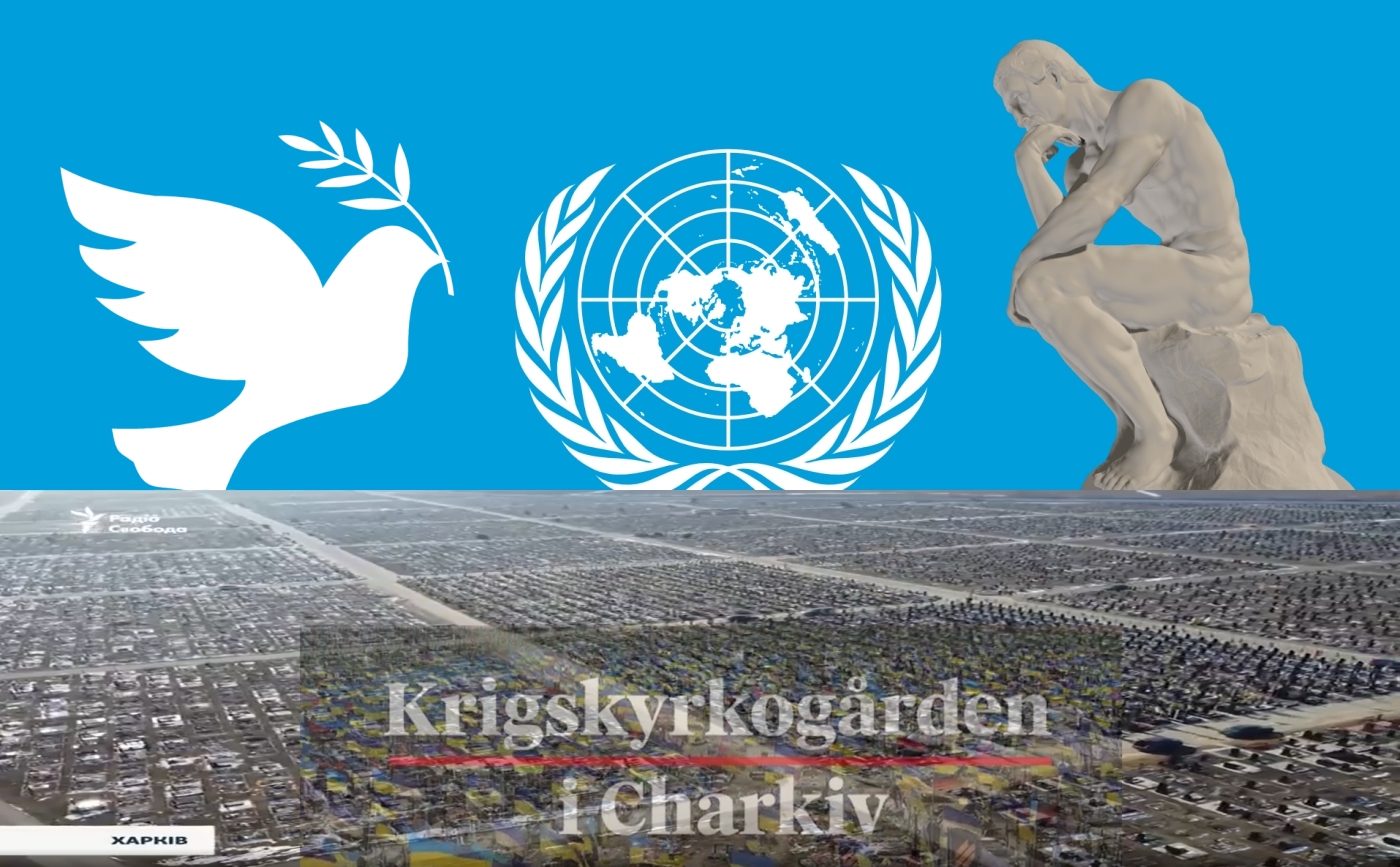
Image sources:
rferl.org and
Wikimedia Commons
The 193 UN states have, by signing the UN Charter,
committed themselves to resolving international disputes by peaceful means and to refrain from the threat or use of force against other states. Unfortunately, however, the UN system has not been enough to stop wars. It is becoming increasingly clear that the UN Charter is in dire need of reform.
The main problem with the UN system is the veto power in the Security Council, which allows the great powers to block resolutions and measures that may be to their disadvantage. Under the current charter, only the Security Council has the ability to intervene in conflicts. If any of the permanent five members (P5: USA, Russia, China, France, Great Britain) votes against a proposal, it falls.
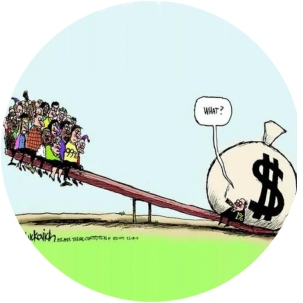
The arms race and wars between states are a democratic problem seen from the perspective that ordinary people in most countries have no interest in going to war. Those who have an interest in war are partly economic actors in the form of weapons producers or raw material exploiters, and partly political actors who seek power out of ideological, religious or economic interest.
To get ordinary people to agree to war preparations and military confrontation, psychological manipulation is required in the form of
propaganda that paints an evil enemy image that whips up fear and motivates escalation to armed conflict.
Democratization or humanitarian intervention is also often used as a pretext in the eyes of world opinion to legitimize war to overthrow governments that are not willing to cooperate.
Is it possible to
create an honest democratic process where the will of the people can shape
a path from ongoing war to conflict resolution and sustainable peace? The method used by citizen assemblies may be a viable way to gain
broader popular support for peace initiatives compared to summits at the political elite level alone.
Show/hide More about War, the arms race and the UN crisis as a democracy problem
Another democracy problem with the UN system is that not all countries are represented in a fair way. Entire continents, such as Africa and Latin America, lack permanent representation on the Security Council, and populous nations such as India also lack permanent influence in the most important decisions.
Following the US's charter-defying military interventions in Venezuela and Iran in early 2026, more and more voices are now being raised from various countries to reform the UN Charter so that the representation problem is improved and the veto right is weakened in some way, perhaps by requiring more than one permanent member to support the veto or by allowing the veto to be overridden by a qualified majority in the General Assembly.
A small group of heads of state and UN representatives have taken up the issue under the coordination of Jeffrey Sachs. They met online at the end of April (https://youtu.be/SHVvg3zG2Is) and will continue to work on the issue. They are based on an ongoing initiative by 40 civil society organizations called The Article 109 Coalition (https://article109.org), which refers to the UN article that deals with how the UN Charter can be formally amended.
The arms race and wars between states are a problem of democracy seen from the perspective that ordinary people in most countries have no interest in going to war. Those who have an interest in war are partly arms producers or economic actors who want to access raw materials or markets, and partly political actors who seek power out of ideological, religious or economic interest. To get ordinary people to agree to war preparations and military confrontation, psychological manipulation is required in the form of propaganda that paints an evil enemy image that whips up fear and motivates escalation into armed conflict.
Sanctions and influence campaigns from an external power to bring about regime change in a recalcitrant country are often justified with democratization as a pretext when the real motive is to get a new government that is willing to let in exploitative companies or allow the establishment of military bases.
In the Ukraine war, Europe has chosen to reject diplomacy between the parties and instead support Ukraine militarily, which continues to lead to more deaths and serious injuries, as well as enormous material destruction and environmental degradation. Currently, there are tens of thousands of deaths every month and a total of two million dead and injured in the war according to CSIS, but the figure is very uncertain because the truth is the first victim of war and both parties understate their own and exaggerate the enemy's losses.
Conflict resolution must ultimately take place through a process where the parties listen to each other and come to a compromise that both can live with. The process and the outcome will be more stable if it is done with the help of neutral and professional conflict managers and mediators.
Sources/reading tips:
- Jeffrey Sachs et al. Revisiting the UN Charter in a Changing Global Order -
Youtube
-
The Article 109 Coalition
Next: Pensions and the financial system as a democratic problem
Up

 THEME DEMOCRACY CRISIS
 Democratic renovation for a sustainable future
 Ancient Democracy - a protection against violence, concentration of power and corruption
 Citizens' assemblies as a method to revitalize democracy
 Pensions and the financial system
 Knowledge deficit and media power
 Climate crisis
 Artificial Intelligence and internet addiction
 Summary - democratic renovation