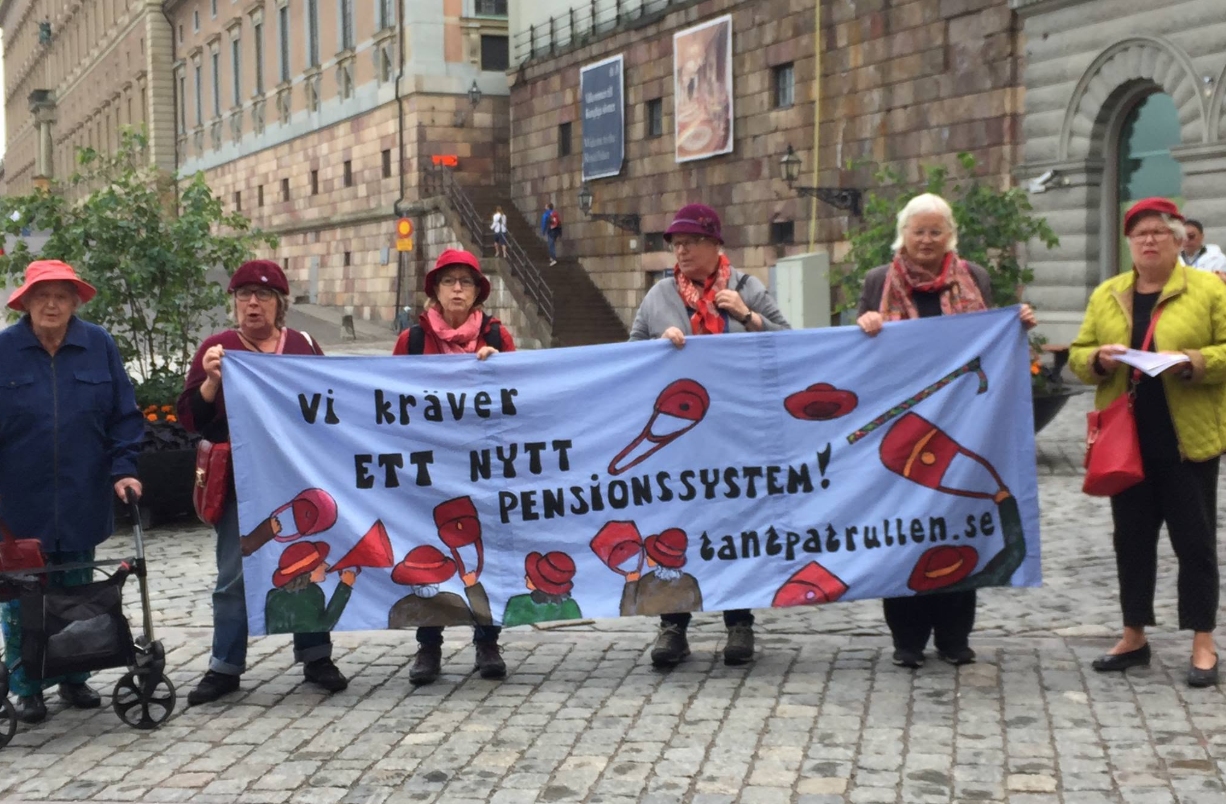
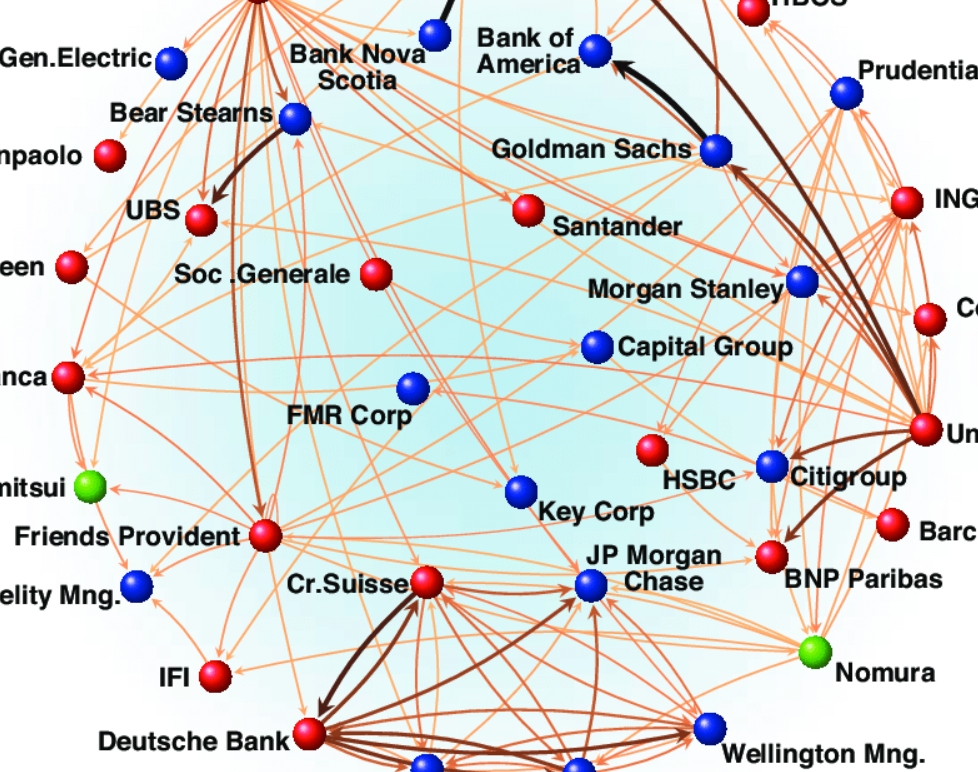
Images: tantpatrullen.se and Douglas-White-4 at https://www.researchgate.net/figure/A-sample-of-the-international-financial-network-where-the-nodes-represent-major_fig1_26692139
. In other words, increased economic inequality. This also means increased democratic inequality, as the increasingly wealthy elite has used its economic power to influence representative democracy through
This is perhaps most evident in the United States and how its party and electoral system has led to a two-party system where both parties are influenced by large campaign contributions from wealthy donors and companies that are part of a network of organizations with a more or less neoliberal ideology.
are dependent on being able to get a sufficiently large return on pension savers' capital, and globally, very large pension capital is seeking returns on the financial market. Because the large asset management companies often take care of these pension funds, they gain great power over how they are invested and, if nothing else is agreed and the return is decisive, they can be invested in the exploitation of oil, gas and coal, which is climate-damaging but often more profitable than other alternatives.
Employees need to have a functioning pension system and a functioning planet for their children and grandchildren. Their priority must be the long-term sustainability of the whole, and therefore it is a problem for democracy that the financial system favors short-term profit interests. Ultimately, the financial system favors increased wealth and power for the already rich, so that economic inequality is increasing.
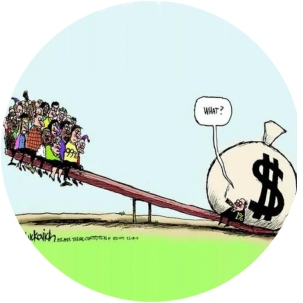
When the richest increase their wealth faster than everyone else, the gaps increase. In the USA it is clear that
political decisions have not worked for increased equality. There are nuances between Democrats and Republicans on certain issues, but the main focus of both parties has long benefited the rich at the expense of the majority of the population. This is visible in the economic statistics where the purchasing power of wage earners has lagged behind for several decades while
the wealth of capital owners has continued to grow and concentrate. It is also seen that
billionaires are spending more and more money on campaign contributions to party election campaigns.
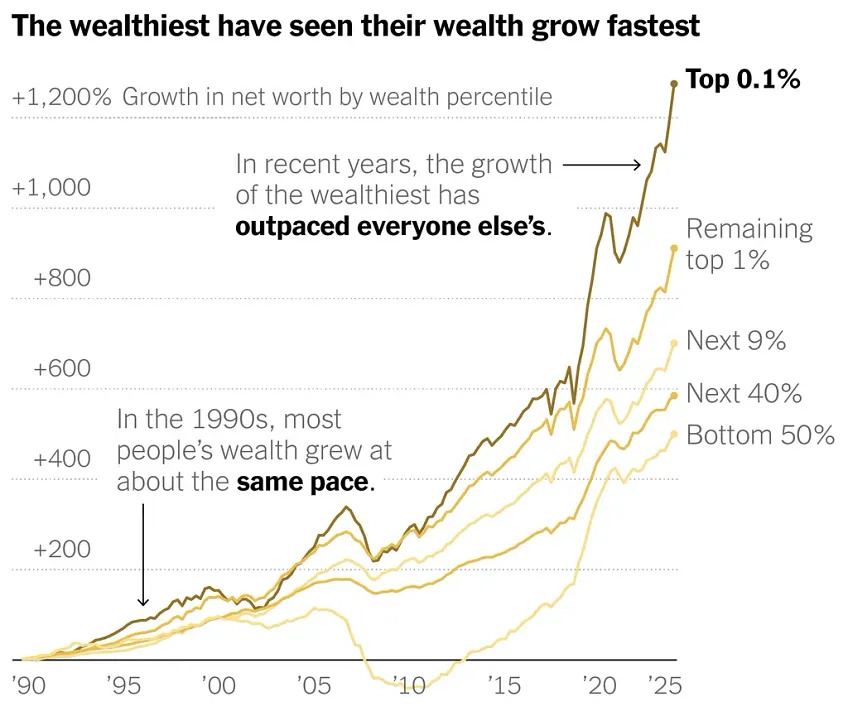
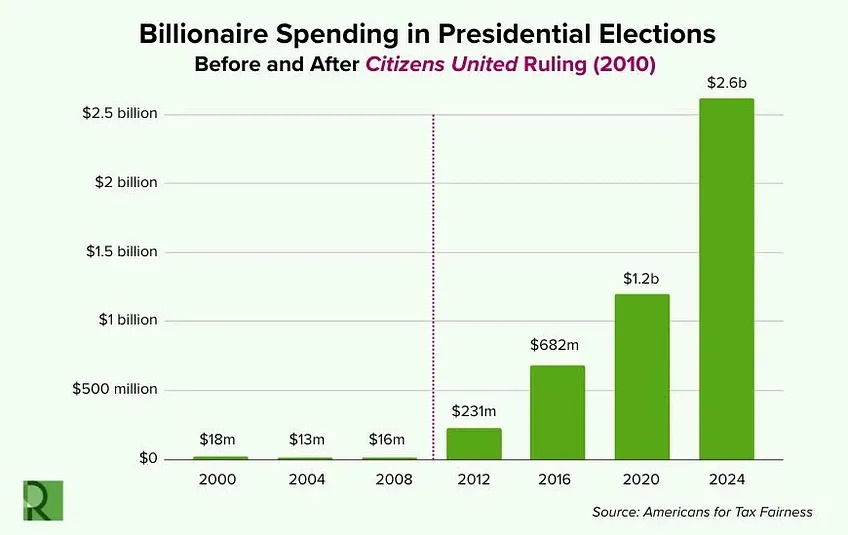
Image source: https://robertreich.substack.com/p/sergey-brin-shows-why-we-must-have
An important, if not decisive
victory for the rich was when the battle over unlimited campaign contributions was settled in 2010 through the Citizens United ruling, which in practice resulted in unlimited power for the rich to
influence laws and taxes to their own benefit.
Economic inequality is also increasing in Sweden.
46 Swedes own more than 8 million people while 730,000 Swedes live in poverty. Swedes' salaries have not kept up with inflation, except for CEOs, whose salaries have increased. Sweden is also the worst in the Nordic countries in combating inequality, something that Oxfam calculated in the report Commitment to Reducing Inequality Index 2022.
The deregulation of the financial system means that a range of different financial “products” are created that are bought and sold on markets without trade being taxed, controlled or slowed down, either by national borders or quantity restrictions.
This system has become like a global casino where the largest players are intermediaries in the form of asset management companies or venture capital companies that, for fees, take care of the capital of smaller players and invest them according to their desired return and risk. Since these intermediaries live on fees and not directly on the return on investments, they have secured income while clients have uncertain income and can make losses in the event of financial crashes.
Examples of the largest players are BlackRock, Vanguard and JPMorgan. The 10 largest companies managed a total of $50 trillion in 2022, which means very great power. Those who sit on the boards of these companies are also part of a
global network of wealthy power players, think tanks, media conglomerates, oil companies, arms companies, security companies, IT companies, etc., all of which focus more on short-term profits than on long-term sustainability.
A notable example of the big players' trick to
secure profits but avoid risks is that a venture capital firm can
buy up a company using borrowed money and the purchased company as collateral, and structure the deal so that the purchased company will own the loan and the risk. If the deal is successful, the venture capital firm can reap large profits through dividends or sales after improving the business or simply increasing its market value. If the purchased company cannot meet its loans and goes bankrupt, it is primarily the lenders (banks) and the company itself that take the brunt, while the venture capital firm's profits have already been taken out of the company and only its own invested capital can be affected by the bankruptcy.
The legislation thus allows financial players to secure large profits through speculative transactions without any significant risk of making a loss, even if the business is mismanaged and goes bankrupt.
Example from the UK:
Southern Cross Healthcare operated around 750 nursing homes and was the UK's largest nursing home company. The company was bought and developed under
ownership by Blackstone. Properties were sold and leased back (sale-and-leaseback), which gave large profits to the owners but increased the company's running costs. Blackstone is said to have made very large profits on its sales. When the economy deteriorated, the rent and debt burden became difficult to bear, and the business collapsed in 2011–2012. Tens of thousands of elderly people and their relatives were affected.
Example from Sweden:
JB Education, formerly known as John Bauer-gymnasierna, is a clear case of bankruptcy. The school group was owned for a period by the
venture capital company Axcel. When the business collapsed in 2013, thousands of students were affected.
Increased popular, democratic influence over the rules of the game for the financial system could shift the focus to favoring increased equality and long-term planning for sustainability instead of the destructive short-termism we have been suffering from for a long time.

 THEME DEMOCRACY CRISIS
 Democratic renovation for a sustainable future
 Ancient Democracy - a protection against violence, concentration of power and corruption
 Citizens' assemblies as a method to revitalize democracy
 Wars, arms race and UN crisis
 Pensions and the financial system
 Knowledge deficit and media power
 Climate crisis
 Artificial Intelligence and internet addiction
 Summary - democratic renovation