Svensk version
Ancient Democracy - a protection against violence, concentration of power and corruption
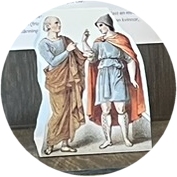

Image source: Wikimedia Commons
In the sixth century BC, Athens was a troubled and divided society. Aristocratic families dominated. Tensions between the elite internally and towards the rest of the people often led to violence. In 508 BC, the Athenian people revolted and in this chaos a man named Cleisthenes managed to organize a reform proposal that the people could accept. This system was called
Demokratia – rule by the people.
The previous aristocratic system, which was based on wealthy families ruling, was now completely rejected. Cleisthenes organized the citizens into ten geographical areas.
All Athenian adult, free men were now given the right to participate, speak and vote in the Pnyx square on all political issues. Each of these men was registered as a citizen of the democracy, a complete reversal of the previous aristocratic organization around families and clans.
These main institutions and mechanisms
were established to avoid concentration of power and corruption:
Ekklesia – The great assembly of the people: all free, adult men had the right to vote.
Boule – 500 randomly selected citizens: One-year terms to prevent professionalization and bribery.
Dikasteria – People’s court where 500 or more randomly selected citizens judged as a jury.
Euthyna – At the end of the term of office of the decision-makers, an examination of their actions and financial dealings was conducted.
The system lasted for about 180 years, until 322 BC.
Flaws in Athenian democracy: Limited inclusion – Only a small part of the population (free, adult men) were citizens, while women, slaves, and foreigners were excluded.
Show/hide More about Antiquity
More about ancient institutions
Ekklesia – The great assembly of the people, the direct democratic decision-making body where all free, adult men had the right to vote. With about 50,000 citizens, this was relatively manageable. Today's representative democracies compromise this direct participation for better or worse in order to be able to handle larger populations.
Boule – Preparatory body that consisted of 500 randomly selected citizens: 50 from each of 10 geographical areas. They often had 2-3 meetings each month. One-year mandates and they did not get a chance for a new mandate until after ten years at the earliest. This was to prevent professionalization and bribery.
Dikasteria – People's court where 500 or more randomly selected citizens judge as a jury. They were entitled to some financial compensation to enable poorer citizens to have the opportunity to participate.
Kleroterion – A mechanical random number generator made of stone and wood with rows and columns of slots for identity cards that were used to randomly select the decision-makers of the term in office in the Boule and Dikasteria.
Euthyna – At the end of the decision-makers’ term in office, an audit of their actions and financial activities was conducted. This can be compared to today’s legislation for limited liability companies and organizations to decide on the discharge of the board of directors at each annual general meeting.
Ostrakismos – Once a year, citizens could vote to banish a decision-maker from the city for up to ten years if he was considered too powerful or dangerous to democracy. This was a safety valve against corruption.
More about flaws in Athenian democracy
Limited inclusion – Only a small part of the population (free, adult men) were citizens, while women, slaves and foreigners were excluded.
Demagogues – Skilled orators could manipulate the popular assembly, sometimes leading to decisions based on emotion rather than reason, a form of political corruption.
Trials – Political trials were sometimes used as a tool by political opponents to smear and drive out competitors.
Sources/reading tips:
-
SO-rummet - Atens demokrati
-
Wikipedia - Athenian_democracy
-
Wikipedia - Kleroterion
- Book: "Can deliberation cure the ills of democracy?" by James S. Fishkin
Next: Citizens' assemblies as a method to revitalize democracy
Up

 THEME DEMOCRACY CRISIS
 Democratic renovation for a sustainable future
 Citizens' assemblies as a method to revitalize democracy
 Wars, arms race and UN crisis
 Pensions and the financial system
 Knowledge deficit and media power
 Climate crisis
 Artificial Intelligence and internet addiction
 Summary - democratic renovation
