Svensk version
Lack of knowledge and media power as a democratic problem


Image sources: abf.se and schibsted.com
If democracy is to prevail and lead to good decisions,
people need to be sufficiently educated as a basis and also be updated on current social problems. In
representative democracy, a lack of knowledge among the people can lead to election results that do not benefit the majority of the people, often after election campaigns with manipulative, misleading messages.
When using
citizens' councils, participants need to be informed by experts and perhaps also by party interests and non-profit organizations about the facts and perspectives available on the current issue.
Special interests with privileged positions always have an advantage in being able to finance advertising campaigns of various kinds to try to manipulate public opinion to vote in their favor. This does not only happen during election campaigns, but also in more permanent and long-term influence strategies that can include sponsored educational materials and the publication of writings, books and films, as well as sponsoring research and conferences with a focus that suits their interests.
In order for ordinary citizens to be able to see through these attempts at influence, they need to have a strong knowledge base and an insight into these conflicts of interest in society.
The long-term interest of the majority is not identical to the more short-term interest of the privileged.
A more enlightened public is of course a threat to the prevailing power structure. But our need for wiser decisions about how to deal with crucial life-threatening problems such as climate change and the military arms race requires better functioning democracies and
therefore, major efforts are needed for system-reflective general education and more democratic control over the mass media.
Show/hide More about Knowledge Lack and Media Power as a Democracy Problem
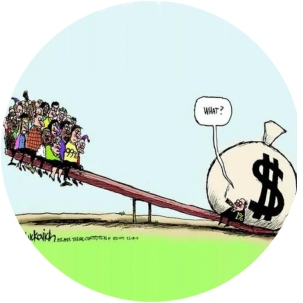
The people who have accumulated the most wealth are often mentally preoccupied with protecting and increasing their wealth, and they collaborate in global networks in various ways to influence social development to their own and the group's advantage. A
power analysis of this kind is something that ordinary people rarely, if ever, come into contact with. Nevertheless, it is something that everyone should have with them as a basic vaccination against being manipulated into agreeing to political proposals that benefit vested interests at the expense of the welfare of the majority of the population and the survival of nature and ecosystems.
With this basic
knowledge base about economic power structures comes an opportunity to seek more knowledge about how wealthy interest groups have built up think tanks, bought up media groups, financed election campaigns and influenced via lobbying in the United States and other countries to the point that formally democratic countries no longer have any truly democratic representation.
A notable and groundbreaking study by political scientists
Martin Gilens and Benjamin Page (2014) showed that the average American voter in practice has close to zero influence on political decisions. Their study analyzed over 1,700 policy decisions in the United States over a 30-year period and compared public opinion with the policies that were actually implemented. The results clearly showed that:
-
Economic elites and large corporations have a large, independent influence on politics.
-
The average citizen and broad interest groups have almost no influence.
-
When the general public gets its way, it is often because their views coincide with what the economic elites and business community already want.
The ideal of democracy is betrayed if the public's view of reality is distorted by news media that do not serve the interests of the people but instead take perspectives that serve their wealthy owners.
In the book
Manufacturing Consent (1988), Noam Chomsky and Edward Herman showed that the mass media in democratic societies basically function as propaganda instruments for the elite. They developed the so-called propaganda model, which explains how news reporting is systematically biased to shape public opinion and ensure public consent to the economic and political interests of the state and large corporations. This
control is carried out through five structural filters:
-
Media ownership and profit interests: Since most large media are for-profit companies, the content is controlled by the interests of the owners.
-
Advertising funding: The primary source of income for the media comes from advertising. This leads to programs and articles that are disapproved by advertisers being filtered out.
-
News sources: The media relies heavily on information from the government, the military, and large corporations ("experts"), which means that the official version is rarely questioned.
-
Flak: Negative feedback, threats of lawsuits, or organized campaigns are used to discipline journalists and silence uncomfortable voices.
-
Anti-communism and fear: Creating a common enemy or ideological threat is used to unite the public and legitimize restrictions or conflicts.
These filters omit or marginalize systemic criticism and events that disadvantage Western elites, while news that benefits them is magnified and presented as objective truth.
Our need for wiser decisions about how to deal with crucial and life-threatening problems requires better functioning democracies and
therefore, major efforts are needed for systemic-critical general education and more democratic control over the mass media in various forms.

 THEME DEMOCRACY CRISIS
 Democratic renovation for a sustainable future
 Ancient Democracy - a protection against violence, concentration of power and corruption
 Citizens' assemblies as a method to revitalize democracy
 Wars, arms race and UN crisis
 Pensions and the financial system
 Climate crisis
 Artificial Intelligence and internet addiction
 Summary - democratic renovation