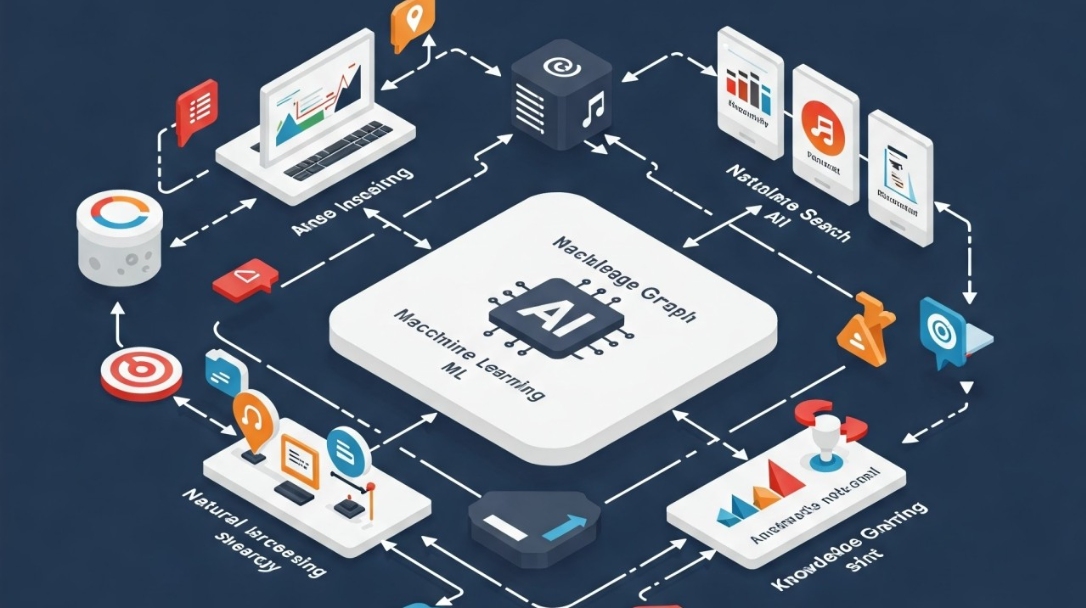
Image source: linkedin.com/pulse/googles-ai-overviews-search-nisha-madhu-pyklf
. He compares the lure of the Internet to the desire for money or the sense of status associated with owning a car. The comparison highlights how a temporary sense of individual freedom hides a deep systemic dependence on infrastructure where control over the system and its conditions involves a
.
. The massive investment in efficiency via Artificial Intelligence means a
so that more and more people are left without income. Production is supposed to increase but
. AI providers think this can be solved by introducing a universal basic income (UBI) or similar systems.
has not been handled sensibly with regard to the environment and climate, as many places in the US have chosen to connect large quantities of
to supply the computer centers. There are at least 35 gigawatts of installed diesel generator capacity at data centers in the US, according to information from the Secretary of Energy.
, while an AI-driven economy that focuses solely on maintaining purchasing power risks producing isolated and powerless consumers. AI also has great potential as a tool for
at different levels, ultimately at a global level but also nationally and locally, linked to a
, so that as many people as possible have the chance to discuss and understand this fundamental issue of power?
In his book
Flight of the Intellectuals and in his broader analyses of the digital surveillance society and the state of crisis, political scientist
Kees van der Pijl, as mentioned above, discusses how
the internet has been transformed into a modern lure and drug. He compares the lure of the internet to the desire for money or the sense of status associated with owning a car. The comparison highlights how a temporary sense of individual freedom conceals a deep systemic dependence where control over the system involves a
power struggle between large private capital and our democratic institutions. The analogy can be divided into three central dimensions:
-
The illusion of total freedom (Owning a car). Individual autonomy: Getting an internet connection or a smartphone gives the individual a sense of infinite mobility and freedom – just as buying your own car gives the feeling of being able to go anywhere, anytime. The hidden dependency: In reality, the car owner is completely dependent on a huge, centralized infrastructure (road network, gas companies, car registrations and laws). Similarly, using the internet requires you to submit to the platforms of the tech giants, invisible algorithms and digital surveillance. In other words, freedom is tightly circumscribed and controlled from above.
-
The universal medium of exchange (The parable of money). Abstract power: Money functions as a universal medium that measures value and mediates human relations under capitalism on an abstract level. Digitally mediated sociality: According to van der Pijl, the internet has become a similar abstract force. It is no longer just a tool, but the medium through which almost all human interaction, information and culture must pass in order to have "value" in modern society. Anyone who is outside the internet is socially and economically bankrupt, just like anyone who is outside the money economy.
-
The lure and the drug (The psychological trap). Instant gratification: Both the car (speed/status) and money (purchasing power/security) have a strong psychological lure that borders on addiction. The digital dopamine: The internet benefits from the same mechanisms but in a much faster cycle. Through constant notifications, likes and tailored information, the web works like a drug. The user is tricked into believing that they are consuming the internet of their own free will, while in fact they are trapped in an infrastructure designed to extract their behavioral data.
Overall, van der Pijl shows how the internet – just like the car and money before it – has gone from being a liberating convenience to becoming an almost absolute necessity for social life, which pressures the individual into obedience under the control system of the global elite if we are unable to take democratic control of the internet.
The AI dilemma. The massive investment in efficiency via Artificial Intelligence means a
dilemma whether people are rationalized away and unemployment increases globally so that more and more people are left without income. Production is supposed to increase but
if purchasing power decreases, the economy will collapse. The AI providers think this can be solved by introducing a universal basic income (UBI) or similar system. The logic behind this reasoning is based on a two-step model in which the economic gains from AI automation are redistributed to maintain market demand:
-
Financing through productivity gains and AI tax. When companies replace human labor with AI, labor costs fall dramatically while productivity increases sharply. AI vendors and advocates (including OpenAI CEO Sam Altman and Elon Musk) argue that the enormous economic surplus generated by AI can be taxed. This "AI tax" or dividend from government funds would then finance the citizen's wage.
-
Sustaining consumption. By guaranteeing all citizens a citizen's wage - a regular, unconditional income, consumers can afford to continue buying goods and services, even though they lack traditional jobs.
In addition to the basic wage, AI vendors and economists point to
two other interacting factors that could reduce the dilemma:
-
Price reductions: As the production costs of food, healthcare and energy approach zero thanks to AI, the cost of living will fall dramatically. Lower purchasing power will therefore be less noticeable because money lasts longer.
-
A new service economy: Freed up time and guaranteed basic income are expected to drive a new wave of entrepreneurship, creative work and human services (e.g. in culture, care and experiences) that AI cannot replicate.
How realistic these hopes for solutions are remains to be seen. Elon Musk's grandiose ideas about colonizing Mars and other crazy technology projects that have failed miserably do not bode well. The energy hunger of AI systems has not been handled sensibly in terms of the environment and climate, as many places in the US have chosen to connect large quantities of diesel generators to supply the data centers. There are at least 35 gigawatts of installed diesel generator capacity at data centers in the US, according to information from the Secretary of Energy.
More on
AI and human redundancy. Being reduced to a consumer without even one's work being in demand can lead to social consequences. When the production sphere is automated, not only a source of income disappears, but also the foundation on which modern democratic society rests. Here are some potential consequences:
-
The loss of collective bargaining power. Historically, popular influence and democratic rights have been gained through workers being able to organize themselves (e.g. in unions). The power of labor lay in the ability to strike and thereby stop production. Consequence: If AI and robots take over production, citizens lose their strongest means of exerting pressure on the elite. A strike among unemployed consumers has no economic effect on the system. Democracy risks being reduced to an empty shell where citizens become completely dependent on the goodwill of the elite (e.g. through the citizen's wage) rather than being active political actors.
-
The existential void and atomization. The workplace has historically been the primary arena for social integration, discipline and meaning-making outside the family. It is where people meet others with different backgrounds and are forced to cooperate. Consequence: Without work, the individual is atomized – she is isolated in her home, tied to digital platforms (which links back to Kees van der Pijl's theories about the internet as a drug). This isolation breaks down social capital and trust in society. People are left without a structured context, which creates a breeding ground for deep existential crisis, alienation and mental illness.
-
Vulnerability to populism and authoritarian movements. Unorganized, isolated and frustrated masses are historically very unstable. Political science research (including Hannah Arendt's analyses of totalitarianism) shows that atomized individuals without social anchorage are the most susceptible to authoritarian propaganda. Consequence: When people lack traditional contexts such as unions or local associations, they seek community elsewhere. The digital landscape offers algorithm-driven echo chambers. This can lead to an explosion of radical, populist or neo-feudal movements that promise order, identity and scapegoats in a world where the individual feels completely superfluous.
-
Consumption without influence (The "neo-feudal" trap). If a basic income is introduced to maintain purchasing power, a paradoxical situation is created. Citizens receive money from the state/tech companies only to immediately send it back by consuming the services and products of the tech companies. Consequence: This creates a total dependency relationship. Man is no longer a free citizen who contributes to the construction of society, but a passive recipient in a closed economic circuit controlled by a technocratic elite. The right to consume replaces the right to shape society.
-
The elites' disconnection from the people. In previous economic systems, the upper class needed the working class to generate wealth. There was a mutual, albeit unequal, dependency. Consequence: If AI makes human labor redundant, this dependency ends. The elite (the owners of the AI infrastructure) no longer need the population even as producers, and if consumption can be simulated or managed via tight circuits, the general public risks being seen as a mere cost or a security risk that must be monitored and controlled, rather than as democratic citizens.
The big problem with democracy is that
democracy requires organized and engaged citizens, while an AI-driven economy that focuses solely on maintaining purchasing power risks producing isolated and powerless consumers.
The Greek economist and politician
Yanis Varoufakis takes the analysis a step further. In his book
Technofeudalism: What Killed Capitalism (2023), he argues that this development means that capitalism is already dead and has been replaced by something much worse: technofeudalism. In short, his view of the dilemma of AI, isolation, and reduced purchasing power is as follows:
-
We are no longer just consumers – we are "Cloud Serfs". Varoufakis believes that the traditional relationship between capitalist and worker has collapsed. When we scroll through social media or train AI models through our digital footprints, we perform free labor that builds the wealth of the tech giants (“cloud capital”). We have been reduced to digital serfs who produce the value that the elite then sell back to us.
-
The market has been replaced by digital fiefdoms. AI vendors do not solve the problem through a free market. Varoufakis emphasizes that platforms like Amazon, the App Store or Meta are not “markets” but digital feudal estates. The tech barons (Amazon, Google, OpenAI) do not necessarily produce things to make a profit, but rather extract digital rent (cloud rent) from everyone else who wants to be visible or sell something on their platforms.
-
Behavior modification replaces purchasing power. Varoufakis warns that the AI of technology companies is not primarily intended to produce goods efficiently, but to directly modify our behavior. By constantly algorithmically controlling our desires, thoughts and purchases, it does not matter if traditional purchasing power decreases. Technology companies have total control over the consumption that actually remains, which makes the individual completely servant to the algorithms.
-
An acute democratic death threat. According to Varoufakis, the major problem of democracy is precisely the atomization of people. When traditional work disappears, physical organization (trade unions and popular movements) also disappears. Since the technology barons have privatized the entire digital public space, there is no common democratic arena left. Democracy becomes an empty shell when a technocratic elite ("cloudalists") has total power over both production and the consciousness of citizens, without the people having any economic means of pressure left.
Varoufakis' conclusion is that it is not enough to passively ask for a citizen's wage from the tech giants. The
only way to save democracy is to socialize cloud capital – that is, to spread ownership of AI and the digital platforms to the citizens, so that they are governed democratically instead of by a few tech barons in Silicon Valley.
There is certainly a lot to Varoufakis' reasoning, but his thesis that capitalism is already dead has been criticized, among other things because industrial production remains on earth, remaining in its capitalist form without having been transformed into cloud capital.
The decisive factor in shaping AI and internet platforms into something human-friendly and into useful tools for the education and democratic development of the majority of the people must ultimately be their ownership. How could a political process develop that leads to their democratic ownership?

 THEME DEMOCRACY CRISIS
 Democratic renovation for a sustainable future
 Ancient Democracy - a protection against violence, concentration of power and corruption
 Citizens' assemblies as a method to revitalize democracy
 Wars, arms race and UN crisis
 Pensions and the financial system
 Knowledge deficit and media power
 Climate crisis
 Artificial Intelligence and internet addiction
 Summary - democratic renovation